Monday, November 04, 2019

Today, Trump Is Scaling Back Rules Restricting Air And Water Pollution

>


Last week, Roland made an announcement: we're done with India. I've been there at least half a dozen times since 1970-- once for over a year-- so I wasn't especially disturbed by the proclamation but I asked why. He said that the air pollution is so deadly in the major cities that it was absolutely unsafe. He has some app he uses that measures air pollution around the world. Last week when the fires in California had driven L.A.'s pollution levels into "unhealthy" (150 was the number and we were supposed to not go outside), the Delhi number was 999, and would have been higher had the app gone into 4 digits. Over the weekend, The Economist backed Roland up. "As part of a 'public-health emergency' declared on November 1st in Delhi, millions of face-masks are being distributed to children. Schools will shut until at least November 5th. The cause is polluted air, which Delhi’s chief minister says has turned the city into a 'gas chamber'. The measures are severe but not unusual. In the past year, schools around the world-- in Thailand and Malaysia, Mexico and America-- have cancelled classes on bad-air days. Air pollution does indeed do terrible things to schoolchildren. Globally, says the World Health Organisation, more than 90% of children under 15 breathe air that puts their health at serious risk. The young are especially susceptible, because their lungs are still developing and their breathing is faster than adults’, so they take in more pollutants relative to their body weight. A British study found that on school-runs young children were exposed to 30% more pollutants than the adults accompanying them, because their height puts them closer to exhaust pipes. One of the most common ailments that results is asthma. Poorer children are still more vulnerable, since their schools tend to be near busy roads."
Children’s brains are also at risk. This is not because pollution confines them to home. Assiduous teachers in Malaysia and China may instruct students online on days when the smog keeps them away from school. In any case, research in 2014 by the Harvard Kennedy School into the effect of shutting schools because of snow shows that missing a few days does not appear to impair learning.

Much more dangerous is the toll that pollution takes on cognitive development and mental health. Research, also conducted in 2014, found that air pollution harmed Israeli students' exam performance. A study in Cincinnati, Ohio, showed an increase in pollution to be correlated with a higher number of psychiatric-hospital visits by children troubled by anxiety and suicidal thoughts. Even very young students are aware of the pollution problem: in a survey by Sustrans, a charity that aims to reduce car use, 45% of British pupils aged four to 11 said they were worried about air quality. Such “eco-anxiety” is the reason that some American school boards are riven by disagreements between environmentalists, who maintain that children need to understand climate change, and administrators who say studying it will traumatise them.

Clean-air campaigners have tried to stem the damage. In Britain, for example, they have, besides encouraging student pick-ups and drop-offs on foot or by bicycle, recommended imposing no-car zones around schools in Birmingham, or, in Sheffield, placing hedges between roads and playgrounds. Such measures are no substitute for bigger changes, though. If trends persist, warns the OECD, a club of mostly rich countries, air pollution will cut 1% from global GDP by 2060, in large part from lost agricultural yield, lower worker productivity and higher health costs. Apart from choking on the fumes, today’s school children can look forward to bearing those burdens, too.
None of that bothers Señor Trumpanzee in the least. He has an election to win and he believes there's a constituency that demands deadly air pollution, particularly coal burning pollution. Yesterday, Juliet Eilperin and Brady Dennis, reported for Washington Post readers on how Trump is working diligently to hamper cognitive development among children and worsen mental health in our own country. Today, the EPA is relaxing "rules that govern how power plants store waste from burning coal and release water containing toxic metals into nearby waterways. The proposals, which scale back two rules adopted in 2015, affect the disposal of fine powder and sludge known as 'coal ash,' as well as contaminated water that power plants produce while burning coal. Both forms of waste can contain mercury, arsenic and other heavy metals that pose risks to human health and the environment." Take that, Obama!

The new Trumpist rules reflect Trumpanzee’s "broader goal of bolstering America’s coal industry at a time when natural gas and renewable energy provide more affordable sources of electricity for consumers. Under the Obama-era rule, coal ash ponds leaking contaminants into groundwater that exceeded federal protection standards had to close by April 2019. The Trump administration extended that deadline until October 2020 in a rule it finalized last year. In August 2018, the U.S. Court of Appeals for the D.C. Circuit instructed the EPA to require that companies overhaul ponds, including those lined with clay and compacted soil, even if there was no evidence that sludge was leaking into groundwater.
In a statement, EPA Administrator Andrew Wheeler said the Obama-era rules “placed heavy burdens on electricity producers across the country.”

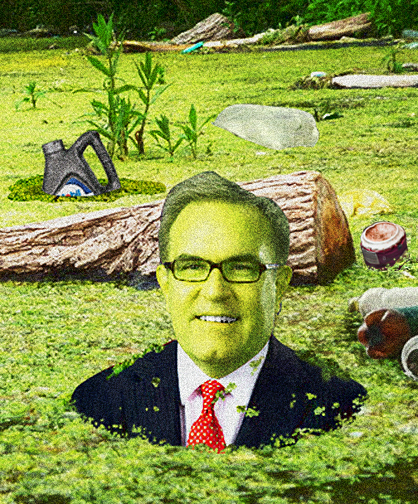
Andrew Wheeler by Nancy Ohanian


“These proposed revisions support the Trump administration’s commitment to responsible, reasonable regulations,” Wheeler said, “by taking a common-sense approach that will provide more certainty to U.S. industry while also protecting public health and the environment.”

... [I]f a company can demonstrate that it is shutting down a coal boiler, it can petition to keep its storage ponds open for as long as eight years, depending on their size. Slurry ponds smaller than 40 acres could get approval to stay in place until Oct. 15, 2023, officials said, while larger ones could remain open until Oct. 15, 2028.

Environmentalists have sharply criticized the proposals, arguing these containment sites pose serious risks to the public at a time when more frequent and intense flooding, fueled in part by climate change, could destabilize them and contaminate drinking water supplies that serve millions of people. The rules will be subject to public comment for 60 days.

During the past decade, Tennessee and North Carolina have experienced major coal ash spills that have destroyed homes and contaminated rivers, resulting in sickened cleanup workers and massive lawsuits.

The question of how to handle coal waste, which is stored in roughly 450 sites across the country, has vexed regulators for decades. The Obama administration negotiated for years with environmental groups, electric utilities and other affected industries about how to address the waste, which can poison wildlife and poses health risks to people living near storage sites.

Lisa Evans, an attorney specializing in hazardous waste law for the environmental group Earthjustice, said allowing the electric industry to extend the life of coal ash pits represents a particular threat to low-income and minority Americans, who often live near such installations.

“Allowing plants to continue to dump toxic waste into leaking coal ash ponds for another 10 years will cause irreversible damage to drinking water sources, human health and the nation’s waters,” Evans said in an email. She added it was not surprising the coal industry had lobbied against closing these storage sites. “Operating ponds is cheap. Closing them costs the utilities money,” she said.

It is also likely to add to ordinary consumers’ costs. Last year, for example, a member of the Virginia State Corporation Commission estimated it could cost ratepayers as much as $3.30 a month over 20 years-- between $2.4 billion and $5.6 billion-- to clean up Virginia-based Dominion Energy’s 11 coal ash ponds and six coal ash landfills in the state.

The Utility Solid Waste Activities Group, which lobbies on coal ash issues on behalf of electric utilities, said in its 2017 petition that the Obama-era rules were “burdensome, inflexible, and often impracticable” and that they “created a monolithic, one-size-fits-all regulatory regime.”

Delia Patterson, general counsel of the American Public Power Association, said the proposed rules would “bring more certainty to the industry and facilitate the safe management” of waste ponds.

...The vast majority of ponds and landfills holding coal waste at hundreds of power plants across the country have leaked toxic chemicals into nearby groundwater at facilities from Texas to Pennsylvania to Maryland, according to that analysis. The report acknowledged, however, that the groundwater data alone does not prove drinking-water supplies near the coal waste facilities have been contaminated. Power companies are not routinely required to test nearby drinking water wells. “So the scope of the threat is largely undefined,” the report stated.

The EPA on Monday will also revise requirements for how power plants discharge wastewater, which contain some of the same kind of contaminants. Under the Obama administration, EPA staff had concluded it was feasible to prohibit any releases of such toxic materials by having the units continually recycle their water. The agency has now concluded this is far more costly than originally anticipated, and technological advances have made it cheaper to filter and capture the waste through a membrane system, officials said.

Under the new rule, plants would be allowed to discharge 10 percent of their water each day, on a 30-day rolling average. The administration projects that the regulation would prevent 105 million pounds of pollutants from being released compared with the old standards because 18 affected plants would voluntarily adopt a more advanced filtration system. The administration also estimated it would save the industry $175 million each year in compliance costs and yield an additional $15 million to $69 million in annual public health and environmental benefits.

However, even if the 18 plants voluntarily adopted more advanced filtration techniques, they represent a minority of the nation’s total number of plants.

Elizabeth “Betsy” Southerland, former director of science and technology at the EPA’s Office of Water, said the proposed rule “relaxes the 2015 treatment requirements allowing increased selenium discharges and [the] release of contaminated water from coal ash handling. Even worse, it exempts a large number of plants from these relaxed requirements, allowing them to discharge more pollutants and continue disposing of ash in leaking ponds.”

Evans said environmentalists are likely to challenge the new rule on coal ash storage and the federal government could again reverse course if a Democrat wins the presidency next year. She noted that, because 95 percent of coal ash ponds remain unlined, two-thirds lie within five feet of groundwater and 92 percent leak more than federal health standards allow, they could pose a risk to the public even as litigation winds its way through the federal courts.

“We have to hope that no wells are poisoned and no toxic waste is spilled in the interim,” she said. “Crossing your fingers is not a legal or sane way to regulate toxic waste.”
ScienceAlert warned last month that air pollution had gotten significantly worse in the U.S. since Trump occupied the White House, "a reversal after years of sustained improvement with significant implications for public health. In 2018 alone, eroding air quality was linked to nearly 10,000 additional deaths in the US relative to the 2016 benchmark, the year in which small-particle pollution reached a two-decade low, according to researchers at Carnegie Mellon University... Last year, EPA Administrator Andrew Wheeler disbanded the expert academic panel that reviewed and advised the agency on its standards for small-particle air pollution. In its place, the administration has hired consultants with links to the fossil fuel, pharmaceutical and tobacco industries... One thing that's clear at the moment is the effect that rising pollution is having on mortality and life expectancy."


Two congressional candidates from Chicago had a lot to say about Trump's-- and conservatives' in general-- love affair with pollution-for-profit and how it impacts the families in their neighborhoods. Kina Collins: "In the predominantly Black and Brown neighborhoods in IL-07, we see food deserts with a lack of fresh produce, industrial corridors pumping toxins into the air, and some areas that have higher levels of lead in the water than Flint, Michigan. In Chicago, there are hotspots where Black children are dying from asthma attacks at eight times the rate of white children because of the air quality and healthcare inequities. This is an environmental crisis. We need to be increasing funding for the EPA and other agencies to immediately and aggressively combat the causes of climate change, not cutting back on regulations and giving tax breaks to polluters. We cannot separate environmental justice from economic justice, and I plan to bring training and opportunities for green jobs into the south and west sides of Chicago so that they do not get left behind as we push to become the world leaders in the green industry. And we need leaders who are at the forefront of Congress pushing for the Green New Deal, who are actually fighting for Generation GND. We can afford to invest in the infrastructure and clean technology needed to end problems like lead in the water, we just need to have the moral authority to put the money where it is needed most. We don't need a Congressman who sits on the sidelines, because our planet doesn't have 20 more years to 'wait and see.' I will be fighting for environmental justice policies from Day One like my life depends on it-- because the future matters to me and to millions of other young Americans who are ready for bold action."

Marie Newman is also running for a seat held by a Democrat who doesn't seem to give a damn about corporate pollution. "With the undeniable amount of rebuilding and work we will have to do to address the climate crisis, my opponent’s lack of understanding and dismissal of the climate crisis alongside the amount of funding he is getting from the fossil fuel industries is truly disturbing. We must push past dinosaurs like Lipinski and get progressives elected ASAP. It is why I’m running."

Labels: , , , , , , ,

Sunday, November 18, 2018

It's Not Just Trump-- The Whole GOP Has A Really Bad Way Of Dealing With The Concept Of An EPA

>


Remember when Trump finally fired Scott Pruitt as EPA head? Did you think he’d find someone less antagonistic towards the environment to replace him? Of course you didn’t. And he didn’t. He named a former coal lobbyist, Andrew Wheeler, as the acting chief and on Friday he announced he’ll submit him to the Senate as the EPA head. Yesterday Brady Dennis and Juliet Eilperin, writing for the Washington Post, broke the not unexpected news: Trump plans to nominate Andrew Wheeler, former coal lobbyist, as EPA chief. The move, of course “would ensure a continued deregulatory push at the agency.” If anything, Wheeler will continue to be far worse than Pruitt… and Pruitt was a complete catastrophe.
During his brief tenure as the EPA’s acting chief, Wheeler has proved far different from the man he replaced. Where Pruitt was a politician who appeared to enjoy the limelight and trappings of Cabinet life, Wheeler has long worked behind the scenes on energy and environmental policy and generally avoids public attention. Along with Health and Human Services Secretary Alex Azar and Veterans Affairs Secretary Robert Wilkie, Wheeler represents the sort of technocrat who has risen through the ranks after an initial Trump Cabinet pick stumbled.

But Wheeler and his predecessor have this in common-- a zeal to deregulate. Wheeler made clear from the start that he intends to carry out many of the regulatory rollbacks set in motion under Pruitt, and to pursue new ones.

“I will try to work to implement the president’s agenda,” Wheeler told the Washington Post shortly after he took over the reins at the EPA this summer. “I don’t think the overall agenda is going to change that much, because we’re implementing what the president has laid out for the agency.”

In the months since, Wheeler has continued to advance Trump’s agenda, proposing rules to loosen carbon limits on power plants and relax fuel-efficiency standards for cars and light trucks. Those proposals, along with moves to change the way the agency calculates the health benefits of new air-pollution standards, have sparked sharp criticism from environmental and public health groups.

...Just this week, Wheeler announced a plan to impose stricter limits on nitrogen-oxide emissions from heavy-duty trucks, winning praise from the trucking industry and the American Lung Association.

Wheeler, like his predecessor, undoubtedly will have the support of industry.

...Wheeler stands a strong chance of winning Senate confirmation, though his nomination is still likely to spur debate. He won approval for his current job in April on a 53-to-45 vote, with three Democrats supporting his nomination. At the time, several Democratic senators questioned his past work for Murray Energy, one of the nation’s biggest coal companies, as well as mining companies and other energy interests.
Two of the three ultra-conservative Democrats who voted for Wheeler’s confirmation last April were defeated in their reelection bids-- Joe Donnelly (IN) and Heidi Heitkamp (ND). It never pays for Democrats to suck up to Trump because Republicans aren’t going to vote for them anyway and by deflating base enthusiasm they wind up losing anyway.

Rhode Island Senator Sheldon Whitehouse: “I hoped Scott Pruitt’s policy dirty work would dry up after he left the EPA in disgrace, but proposals like the forthcoming rule to weaken or eliminate protections against mercury emissions make it clear Andrew Wheeler plans to continue... with rollbacks of vital environmental protections."


Labels: , ,

Thursday, July 12, 2018

People Expect The New EPA Administrator To Be Less Incompetent And Distracted Than Pruitt-- And That's Not A Good Thing

>

Worse than Pruitt?

Yesterday, the New York Times reported that "Scott Pruitt’s brief, tumultuous tenure as the head of the EPA has left him disgraced in the eyes of many in Washington and across the country. But it may not have done him much harm in his home state. Though a comeback for Mr. Pruitt is far from assured, some liberals and conservatives in Oklahoma agree he could engineer one in this oil- and gas-dependent state where he used to be attorney general. His hard-line anti-regulatory message remains popular here, and many of his supporters consider the spreading plume of scandal from his time at the EPA the product of unfair liberal persecution."

Susan Dudley, writing for Forbes, reported that Pruitt had pursued the largest regulatory rollback in the EPA’s history... but when it came to actual deregulation Pruitt was too busy feathering his own nest and stealing everything he could get his hands on that wasn't nailed down to complete much of what he started.
EPA has issued significantly fewer new regulations than in previous years. During his tenure as administrator, EPA has finalized only 15 actions compared to 38 rules finalized during the same period in the Obama administration. But slowing the pace of new regulation is not the same as “rolling back” existing rules.

Of the 15 final actions Pruitt has presided over, the Office of Management and Budget (OMB) classifies five as “deregulatory,” two as “regulatory” and eight as neither. Only one of the so-called deregulatory actions actually removes an existing requirement; in response to a petition, it exempts certain treated railroad ties from being classified as solid waste when used as fuel. One action imposes user fees on electronic manifest submissions (raising questions as to why it is considered deregulatory) and the other three extend compliance deadlines for regulations issued in the previous administration. Extensions provide head room to review and modify not-yet-effective rules in the future, but are not exactly rollbacks.

The two completed actions identified as regulatory are also rather modest in scope. One requires public notice for combined sewer overflows into the Great Lakes, and the other establishes reporting requirements for manufacturers, users or importers of mercury.

The only “economically significant” final action EPA has taken during this administration is its renewable fuel standard issued last December. Although OMB’s accounting does not classify it as such (it is labeled “other”), this action is decidedly regulatory. As I have observed in previous columns, renewable fuel mandates are costly to consumers and the environment, and only serve to enrich powerful special interests.

The paucity of actual regulatory or deregulatory activity over the last year-and-a-half partly reflects the reality that changing existing policies through rulemaking takes time and resources. Once a regulation is in place, any changes to it require careful analysis of likely impacts, public notice supporting and explaining the proposed change, and the consideration of public comment and interagency review. Complying with these statutory and administrative requirements can take years. Particularly when reversing regulatory requirements established by a previous administration, development of a robust public record is essential for new policies to withstand the inevitable legal challenges.

EPA’s agenda of regulatory and deregulatory activities lists 128 actions underway in various stages of rulemaking. These comprise 41 deregulatory actions of which four are economically significant (with estimated dollar impacts in the hundreds of millions or billions), and likely to get a lot of attention. They include repeals of the prior administration’s clean power plan and truck glider rules, modification of vehicle economy standards, and reconsideration of oil and gas sector emissions standards.
But they like him in beet red, oily Oklahoma. Jim Dunlap, a GOP consultant, was a Republican legislator for 16 years. He defends Pruitt who, he says, dies not represent the D.C. swamp but it's his critics who do. "It's just an atmosphere in Washington, D.C. It's-- say, if they don't agree with me, I'm going to go ruin them. And I think Scott realized that. He fought as hard as he could. And it just got to a point where it became too personal. And he said, you know, somebody else can do it." This guy-- and I guess many of Republicans-- seems to be living in their own reality. He doesn't seem to understand that Pruitt didn't resign but went kicking and screaming as he was fired and dragged out of his office and tossed onto the garbage heap of history.


Still, extremists, like Dunlap, would love to see Pruitt run for Jim Inhofe's Senate seat if he dies or retires (Inhofe is 83 and increasingly senile). I bet plenty of Democrats would too.

Labels: , , , ,

Friday, July 06, 2018

Yesterday Ed Schultz Died And Trumpanzee Finally Fired Pruitt

>


Ed Schultz died yesterday, age 64. I used to love watching him on MSNBC. I lost track of him since they fired him, although I stumbled onto a YouTube of his recently on that Russian propaganda network he was working for-- and I was appalled. It's better not to mention what I saw. Instead, let's remember that MSDNC fired him because he had planned live coverage of Bernie's announcement of his presidential campaign in 2015. He was at Bernie's headquarters with a crew, preparing for a remote, when he was told by phone to cancel the live coverage and cover something inconsequential. He was fired soon after that. As for the Russian propaganda thing... everyone's gotta make a living, I suppose. It's just that when you feel you "know" and trust someone from the mass media, you have expectations which are painful to see shattered. Trump isn't shattering any of his fans' expectations. The moron from the TV show is the moron they voted for and the moron the rest of us-- and the world-- are all stuck with. Speaking of which...

Where were you when you first heard Trump had finally pulled the plug on Pruitt? Our friend Skip Kaltenheuser had some mixed feelings about the news: "Actually, I’m disappointed to see Pruitt go," he told me. "It’s not often one gets a neon sign spelling venality." How about you? Were you reading Trump's twitter feed? I think Evan Halper of the L.A. Times got the story out first, although he referred to it as a resignation rather than a firing, more Beltway dishonesty that fool no one but fools. The "scoop," though, was just a report on Trump's tweet: "Environmental Protection Agency chief Scott Pruitt, one of the most scandal-plagued Cabinet officials in U.S. history, is leaving the agency, President Trump tweeted Thursday."

The good news is that Pruitt is gone and the bad news is that Andrew Wheeler, his deputy, take over Monday, as acting administrator. Trumpanzee: "I have no doubt that Andy will continue on with our great and lasting EPA agenda. We have made tremendous progress and the future of the EPA is very bright!"

Wheeler is a former coal-industry lobbyist. Jeff Turrentine, back in April: "If you’re hoping Wheeler could represent some sort of departure from Pruitt’s (literal) scorched-earth agenda, he wouldn’t. While it may be impossible to imagine anyone worse than Pruitt to lead our nation’s environmental policy, plenty of individuals could be just as bad. And as he’s shown us on numerous occasions, President Trump has a sixth sense for ferreting these people out and putting them on the executive-branch payroll. So who is Andrew Wheeler? And what is it about his particular career trajectory that makes the White House, energy-company executives, and assorted climate deniers think he’s a perfect fit for the Trump-era EPA?... In his spare time, Wheeler serves as the vice president of the Washington Coal Club, a powerful yet little-known federation of more than 300 coal producers, lawmakers, business leaders, and policy experts who have dedicated themselves to preserving the uncertain future of our dirtiest fossil fuel."


The departure of the anti-regulatory crusader ends a bizarre and tumultuous chapter of the Trump administration that puzzled even some of the president’s staunchest supporters.


The spendthrift EPA chief has been a political liability for the White House for months, drawing the attention of federal investigators with scandal after scandal, many of which were linked to his lavish spending of taxpayer money and the use of his position to enrich his family. Pruitt leaves the post the target of more than a dozen official probes.

The transgressions span from Pruitt’s deal with the wife of a top energy lobbyist for deeply discounted housing, huge raises he gave friends against the instructions of the White House and his penchant for flying first class. Pruitt used his office to try to secure his wife a Chick-fil-A franchise and also enlisted aides to try to help her land lucrative work elsewhere. He had a $43,000 phone booth installed in his office.

“Scott Pruitt’s corruption and coziness with industry lobbyists finally caught up with him,” said Erich Pica, president of Friends of the Earth, an environmental advocacy group. “ We’re happy that Pruitt can no longer deceive Americans or destroy our environment.”

The executive director of Citizens for Responsibility and Ethics in Washington issued a one-word statement: “Good.”

Though President Trump initially backed Pruitt and prominent conservatives had lobbied to keep him in place, the scandals eventually made Pruitt too much of a liability for the administration.

Pruitt has been seen by conservatives as among Trump’s most effective Cabinet members, aggressively dismantling clean water and air rules, working from the inside to weaken the agency’s authority and rolling back the Obama-era climate action loathed by fossil fuel companies.

The latest Cabinet shuffle reflects a remarkable turnabout for Pruitt, once a rising GOP star. The EPA position was seen by Pruitt’s allies as a launchpad for bigger ambitions, such as a run for the Senate or Oklahoma governorship, and possibly even the presidency.

But that political future has been thrown into doubt amid investigations into behavior the White House was unwilling to defend, such as the unauthorized purchase of the soundproof phone booth meant to deter eavesdroppers.

The departure is a blow to anti-regulatory activists eager to see the rules of the Obama era scrapped. Several of the battles Pruitt launched against regulations, such as the aggressive fuel economy standards championed by California and the federal Clean Power Plan aimed at reducing electricity plant emissions, are likely to endure for years. The Trump administration already was sprinting to get the rules rewritten and through court challenges before the next presidential election.

The shake-up could slow that work and give environmental groups and the coalition of states fighting Pruitt’s agenda an advantage.

Still, in his short time at the EPA, Pruitt managed to do more to undermine the environmental protection work of its career scientists, analysts and enforcement officers than any leader of the agency since the early days of the Reagan administration. And the appointment of former coal industry lobbyist Wheeler as acting head ensures the Pruitt agenda will endure. Former agency chiefs-- including some who served GOP presidents-- expressed alarm at Pruitt’s climate denialism and his hostility toward many bedrock environmental rules.

“I have no doubt and complete confidence [Wheeler] will continue the important deregulatory work that Scott Pruitt started while being a good steward of the environment,” said Sen. Jim Inhofe (R-OK), adding Wheeler worked for him for 14 years.

Pruitt often was unabashedly at war with his own agency, alleging it was under the control of activist bureaucrats working in tandem with environmental groups to impose a radical agenda. When his ethics problems became insurmountable, he blamed his troubles on those same forces, accusing them of manufacturing controversy to thwart his deregulation push.

But concern about Pruitt’s ethics issues ultimately reached the White House, where Trump advisors worried his spending habits and management undermined Trump’s vow to “drain the swamp” of government waste and corruption. Iowa Republican Sen. Joni Ernst, a Trump ally, said in June that Pruitt “is about as swampy as you get.”

The housing arrangement, which Pruitt likened to “an Airbnb situation,” allowed him to stay in a condo a block from the Capitol for $50 a night, paying only for nights he was in town-- far below market rates for such a room.

Pruitt also helped two of his confidants secure giant pay raises against White House instructions. After getting turned down by the White House, the EPA granted the raises by invoking a provision of the Safe Drinking Water Act that allowed Pruitt to make up to 30 hires without White House or congressional approval. The salary of one of the aides was boosted to $164,200 from $107,435. The other saw a salary increase from $86,460 to $114,590.

As the housing and salary hike controversies emerged, Pruitt already was battling fallout from his tendency to fly first class for government travel, and also arranging his taxpayer-funded trips so he could spend weekends at his home in Oklahoma. Pruitt said security concerns demanded he fly in the luxury cabin, but it was a clear departure from the practice of past EPA leaders. A member of his security detail said flying in coach exposed him to angry members of the public.

Reports that Pruitt sidelined EPA staffers who objected to his requests for special treatment didn’t help his case. The Pruitt requests that caused staff to bristle, according to the New York Times, included the blaring of government vehicle sirens to cut through traffic on routine trips, his first-class plane trips and a security detail three times the size of that of his predecessors. There also was a request for a bulletproof vehicle with tires resistant to gunfire.

As Pruitt struggled to explain it all, more scandals kept emerging. Emails obtained by the Sierra Club revealed how Pruitt had his staff schedule a meeting with the CEO of Chick-fil-A, with the goal of landing his wife a franchise. Reports emerged that he tasked them with such things as acquiring a used mattress, tracking down the luxury skin lotion he prefers and using their personal credit cards to cover his hotel bills.

By July, it was clear that even some of Pruitt’s most loyal aides would no longer protect him. They detailed for congressional investigators more of the agency chief’s questionable conduct, including tasking aides with finding his wife a job. The White House communications staff had long since stopped defending Pruitt, and so had many conservatives.

Yet Trump continued tweeting his praise. Now, it seems, even the president has had enough of the turmoil Pruitt added to his administration.
Elizabeth Warren was more to the point. "I'm glad that Scott Pruitt resigned," she wrote moments after Trump tweeted the announcement. "A man who doesn’t believe in climate change never should have been in charge of the Environmental Protection Agency in the first place. And a government official that corrupt should have been fired by the President of the United States 28 scandals ago. But let’s get real: Donald Trump’s cabinet is full of people who have no business running their agencies. Betsy DeVos at the Education Department. Steve Mnuchin at Treasury. Jeff Sessions at the Justice Department. Mick Mulvaney and his part-time work at OMB and the CFPB. And now Scott Pruitt’s temporary replacement at the EPA is a longtime Washington insider and corporate lawyer who’s done the bidding of fossil fuel companies for decades. The only way to stop Donald Trump from filling his cabinet-- and the courts-- with people who work against the interests of the American people is to take back control of the Senate this November."


Labels: , , , ,