Wednesday, June 10, 2020

Americans May Be Ready For Real Change-- And We're Stuck Choosing Between Two Status Quo Stiffs

>

What? by Chip Proser

It's been about 2 weeks since several officers from the Minneapolis police department brutally and virtually routinely murdered George Floyd and then lied about it, not knowing they would be exposed by a cell phone tape. Those officers are responsible for a "Defund the Police" movement and more. Yesterday, Axios reported that the ugliness that has been nearly routine for Black America is now being exposed for everyone else in the country. And-- except for hard core Trump fanatics, no one likes it. A brand new poll of Michigan likely voters asked "Are deaths of black individuals isolated incidents, or signs of a bigger problem?" 68% said it was part of a bigger problem. Asked if policing practices need reform, 76% said yes and only 15% said no. When asked if demonstrators should be permitted to carry guns inside the state Capitol, 80% said no and just 13% said yes.
It's no longer the word of a police officer vs. the suspect. Now it's the police officer vs. video cameras, often held by members of the communities they patrol. At least three big police departments have been caught in the act in just the past few weeks because of video footage, AP notes.
Minneapolis police initially told the public that George Floyd resisted arrest and that he died after a "medical incident during a police interaction." But George Floyd didn't resist arrest, and the Minneapolis police omitted the knee that a former officer placed on his neck for almost 9 minutes.
Buffalo police said a protester "tripped and fell." Protester Martin Gugino, 75, was pushed by Buffalo police officers and suffered brain damage. President Trump tweeted a conspiracy theory about Gugino today, but you can watch the tape for yourself. The man was shoved to the ground by cops, and no one stopped to help. Even a handful of Republican senators recognize Trump's response as a potential catastrophe for the GOP and are trying to distance themselves from it.
Philadelphia police alleged that a college student who suffered a serious head wound had assaulted an officer. The Philadelphia officer was seen on video striking a 21-year-old Temple University student in the head and neck with a metal baton. That student was released after prosecutors saw the video and decided to pursue the officer instead.


Civil rights lawyer Michael Avery, who is the board president of the National Police Accountability Project, told the AP that false claims by the police had long been known to inner-city communities. "But what is happening now with video, this is getting out into the larger world, into the media, into white communities, suburban communities, and people outside the affected communities are becoming more aware of what’s going on," he said. "It’s a completely different situation."
A Washington Post poll also found that most people are not all that sympathetic with the police. Dan Balz and Scott Clement wrote that "Americans overwhelmingly support the nationwide protests that have taken place since the killing of George Floyd at the hands of police in Minneapolis, and they say police forces have not done enough to ensure that blacks are treated equally to whites... Trump receives negative marks for his handling of the protests, with 61 percent saying they disapprove and 35 percent saying they approve. Much of the opposition to Trump is vehement, as 47 percent of Americans say they strongly disapprove of the way the president has responded to the protests."
The poll highlights how attitudes about police treatment of black Americans are changing dramatically. More than 2 in 3 Americans (69 percent) say the killing of Floyd represents a broader problem within law enforcement, compared with fewer than 1 in 3 (29 percent) who say the Minneapolis killing is an isolated incident.

That finding marks a significant shift when compared with the reactions in 2014 to police killings of unarmed black men in Ferguson, Missouri, and New York. Six years ago, 43 percent described those deaths as indicative of broader problems in policing while 51 percent saw them as isolated incidents.


Overall, 74 percent of Americans say they support the protests that have been carried out in cities and towns across the country since the May 25 killing of Floyd, which occurred after police held him on the ground and one officer pressed his knee to the victim’s neck for nearly nine minutes. “I can’t breathe,” Floyd said as he died.

The recent demonstrations have bipartisan appeal, with 87 percent of Democrats saying they support them, along with 76 percent of independents. Among Republicans, the majority-- 53 percent-- also back the protests.

The widespread support for the protests comes amid mixed views of whether those events have been mostly peaceful or mostly violent. On that question, Americans are evenly divided, with 43 percent saying the protests have been mostly peaceful and an identical percentage describing them as mostly violent. Thirteen percent say the protests have been equally peaceful and violent.

Views on this split along ideological and partisan lines: Most liberals (70 percent) and Democrats (56 percent) say the protests were mostly peaceful, while most conservatives (60 percent) and Republicans (65 percent) say they were largely violent. Independents are split similarly to the country overall, with 44 percent saying the protests were mostly peaceful, 42 percent mostly violent.

But support for the protests is evident regardless of whether they are seen as mostly violent or mainly peaceful.

...Casting ahead to the November election, which pits Trump against former vice president Joe Biden, half of all Americans (50 percent) say they prefer a president who can address the nation’s racial divisions, compared with 37 percent who say they want a president who can restore security by enforcing the law.


...Republicans generally agree with views of the protests expressed by Trump. Last week he called himself “your president of law and order and an ally of all peaceful protesters” in a Rose Garden statement, made as police and military troops forcibly cleared a demonstration near the White House. He also said the country was in the grip of “professional anarchists, violent mobs, arsonists, looters, criminals, rioters, antifa and others.” He told mayors and governors that they needed to dominate the streets to restore order.

More than 7 in 10 Republicans approve of Trump’s handling of the protests, a view shared by just over one-third (35 percent) of the overall population. Republicans also have a more negative view of the protests; while 43 percent of the public says the protests have been “mostly violent,” 65 percent of Republicans hold this view.

Almost half of all Americans (47 percent) say police have not used enough force in responding to episodes of looting and vandalism, a figure that rises to 72 percent among Republicans. And 63 percent of Republicans say they prefer a president who would restore security, when 50 percent of the overall population instead prefers someone who could deal with the country’s racial divisions.


Yesterday, the AFL-CIO's General Board endorsed what they claim is "a sweeping set of policing reforms" proposed by the Leadership Council on Civil and Human Rights, expressed support and solidarity with the Minnesota AFL-CIO's call for the resignation of the President of the Minneapolis Police Union (not affiliated with the AFL-CIO), expressed support for the King County Labor Council (Seattle)'s demands on the Seattle police union that they renounce racist practices of face expulsion, and committed the AFL-CIO to an accelerated and intensified process of internal dialogue and change around race in our own institutions. "The scourge of police violence against black people in America has reached a tipping point," get said in their statement, "and it is critical that we take comprehensive action to end this injustice once and for all. Union members live and work in every state and every community, so when police brutality occurs, it happens in our backyards and to our families. As such, we feel a special responsibility in the wake of George Floyd’s murder to support our civil rights allies and play a leading role in making sure this time is different. Whether it’s banning chokeholds, expanding use of body cameras, ending racial profiling, demilitiarizing our police forces or limiting no-knock warrants, the LCCHR’s recommendations on police reform have the potential to create a fairer, more community-centric policing culture."


Labels: , ,

Thursday, April 23, 2020

There Is A Safe Way To Open The Economy Back Up Again-- And Then There Is The Republican Way... Which Could Bring On Curve Steepening, Economic Depression And Food Shortages

>


I started listening to Chris Martenson's daily coronavirus podcasts in late January and the posting them at DWT a few weeks later. Lucky for me and for some of the readers. Because of Martsenson's warnings I got an early understanding of what this pandemic was going to be like-- and what I could do to protect myself and my family and friends. Long before it was too late, we all had N-99 and N-95 respirator masks. I bought 3 months worth of root vegetables, pasta, dried beans, grain, cooking oil, paper goods, bottled water, etc. I moved much of my retirement savings from equities to bonds and other less volatile vehicles, like real estate investments. I bought rubber gloves and Hebiclens and consulted with my doctor about my own personal vulnerabilities and what she thought I should do about protecting myself.

Out for a stroll in the neighborhood


But there was one step that Martsenson kept talking about that I resisted... until now. It was too scary to contemplate: starting a vegetable garden. But he's been right about every single thing and ahead of every single curve, so the worry had gnawed at me from the inside. So, when Jacquie from Blue America recommended a gardening system even I could handle-- the one she uses-- I went for it. When I was a around 15-16, I had had it with America and decided to leave. I spent a whole winter stealing packets of seeds and gardening equipment and other necessities from a 5 and dime on Kings Highway in Brooklyn and making parcels for myself and sending them to me at poste restante in Nukuʻalofa, the capital of Tonga. Eventually, I hitch-hiked from Brooklyn to San Pedro in L.A. and stowed away on a ship going to New Zealand, where I intended to stow away on the mail boat that went to Tonga every other month. I got caught on the ship before it left San Pedro. I wonder what happened to all those seeds and tools and things I sent to Nukuʻalofa.

Yesterday I read a piece in The Guardian by Fiona Harvey about the pandemic causing a famine of biblical proportions. Harvey wrote that the chief of the UN’s food relief agency has warned that mankind "is facing widespread famine 'of biblical proportions' because of the coronavirus pandemic."
Covid-19 is likely to be sweeping through the developing world but its spread is hard to gauge. What appears to be certain is that the fragile healthcare systems of scores of developing countries will be unable to cope, and the economic disaster following in the wake of the pandemic will lead to huge strain on resources.

“This is truly more than just a pandemic-- it is creating a hunger pandemic,” said David Beasley [executive director of the World Food Program]. “This is a humanitarian and food catastrophe.”

According to a report produced by the UN and other organisations on Thursday, at least 265 million people are being pushed to the brink of starvation by the Covid-19 crisis, double the number under threat before the pandemic.

None of those looming deaths from starvation are inevitable, said Beasley. “If we get money, and we keep the supply chains open, we can avoid famine,” he said. “We can stop this if we act now.”

He said the situation even four weeks from now was impossible to forecast, stressing that donors must act with urgency. He urged countries not to put in place export bans or other restrictions on the supply of food across borders, which would lead to shortages.

...Also crucial is ensuring that supply chains stay open in the face of lockdowns and the difficulty of getting workers into the fields to tend crops if they are sick or unable to travel easily. “If the supply chain breaks down, people can’t get food-- and if they can’t get food for long enough, they will die,” said Beasley.
Yesterday the NY Times' Abdi Dahir reported a similar dire situation: "The world has never faced a hunger emergency like this, experts say. It could double the number of people facing acute hunger to 265 million by the end of this year." The scary headline: "Instead of Coronavirus, the Hunger Will Kill Us." He wrote about food shortages in Africa, India, Colombia. "The coronavirus pandemic has brought hunger to millions of people around the world. National lockdowns and social distancing measures are drying up work and incomes, and are likely to disrupt agricultural production and supply routes-- leaving millions to worry how they will get enough to eat. The coronavirus has sometimes been called an equalizer because it has sickened both rich and poor, but when it comes to food, the commonality ends. It is poor people, including large segments of poorer nations, who are now going hungry and facing the prospect of starving."
This hunger crisis, experts say, is global and caused by a multitude of factors linked to the coronavirus pandemic and the ensuing interruption of the economic order: the collapse in oil prices; widespread shortages of hard currency from tourism drying up; overseas workers not having earnings to send home; and ongoing problems like climate change, violence, population dislocations and humanitarian disasters.

Already, from Honduras to South Africa to India, protests and looting have broken out amid frustrations from lockdowns and worries about hunger. With classes shut down, over 368 million children have lost the nutritious meals and snacks they normally receive in school.

There is no shortage of food globally, or mass starvation from the pandemic-- yet. But logistical problems in planting, harvesting and transporting food will leave poor countries exposed in the coming months, especially those reliant on imports, said Johan Swinnen, director general of the International Food Policy Research Institute in Washington.

While the system of food distribution and retailing in rich nations is organized and automated, he said, systems in developing countries are “labor intensive,” making “these supply chains much more vulnerable to Covid-19 and social distancing regulations.”
And in the U.S.? There are reports that "an emerging shortage of carbon dioxide gas (CO2) caused by the coronavirus pandemic may affect food supply chains and drinking water, a Washington state emergency planning document has revealed. The document, a Covid-19 situation report produced by the State Emergency Operations Center (SEOC), contains a warning from the state’s office of drinking water (ODW) about difficulties in obtaining CO2, which is essential for the process of water treatment... 'Several [water plants] had received initial notification from their vendors that their supply would be restricted to 33% of normal.'" This seems solvable. But what about the food supply chain in the U.S.? Meat seems like a big probem, albeit not for vegetarians (like myself). I noticed that grocery stores this week that had been missing organic produce two weeks ago-- like roma tomatoes, belgian endives and melons-- were amply stocked this week. Boxes of pasta are back on the shelves... as is seaweed, rice and, yes, toilet paper. But... this is California. What about other parts of the country?
The nation’s food supply chain is showing signs of strain, as increasing numbers of workers are falling ill with the coronavirus in meat processing plants, warehouses and grocery stores.

The spread of the virus through the food and grocery industry is expected to cause disruptions in production and distribution of certain products like pork, industry executives, labor unions and analysts have warned in recent days. The issues follow nearly a month of stockpiling of food and other essentials by panicked shoppers that have tested supply networks as never before.

Industry leaders and observers acknowledge the shortages could increase, but they insist it is more of an inconvenience than a major problem. People will have enough to eat; they just may not have the usual variety. The food supply remains robust, they say, with hundreds of millions of pounds of meat in cold storage. There is no evidence that the coronavirus can be transmitted through food or its packaging, according to the Department of Agriculture.

Still, the illnesses have the potential to cause shortages lasting weeks for a few products, creating further anxiety for Americans already shaken by how difficult it can be to find high-demand staples like flour and eggs.

“You might not get what you want when you want it,” said Christine McCracken, a meat industry analyst at Rabobank in New York. “Consumers like to have a lot of different choices, and the reality is in the short term, we just don’t have the labor to make that happen.”

In one of the most significant signs of pressure since the pandemic began, Smithfield Foods became the latest company to announce a shutdown, announcing Sunday that it would close its processing plant in Sioux Falls, S.D., after 230 workers became ill with the virus. The plant produces more than 5 percent of the nation’s pork.

“The closure of this facility, combined with a growing list of other protein plants that have shuttered across our industry, is pushing our country perilously close to the edge in terms of our meat supply,” Smithfield’s chief executive, Kenneth M. Sullivan, said in a statement.

As of Saturday, the plant’s Covid-19 cases were more than half South Dakota’s active total, Gov. Kristi Noem said. She called the outbreak an “alarming statistic” and asked Smithfield to shut down the facility for two weeks.

The problems at the Sioux Falls pork plant show the food processing industry’s vulnerability to an outbreak. Employees often work shoulder to shoulder, and some companies have granted sick leave only to employees who test positive for the coronavirus. That potentially leaves on the job thousands of other infected workers who haven’t been tested, hastening the infection’s spread.

Other major processors have had to shut down plants. JBS USA, the world’s largest meat processor, closed a plant in Pennsylvania for two weeks. Last week, Cargill closed a facility in Pennsylvania where it produces steaks, ground beef and ground pork. And Tyson halted operations at a pork plant in Iowa after more than two dozen workers tested positive.

“Labor is going to be the biggest thing that can break,” said Karan Girotra, a supply-chain expert at Cornell University. “If large numbers of people start getting sick in rural America, all bets are off.”

At the other end of the supply chain, grocery stores are also dealing with increasing illnesses among workers, as well as absences by those afraid to go in to work.

Even as company officials called them “essential” for their role in feeding the country, grocery store workers went weeks without being provided with face masks and other protective gear.

Some food companies have been slow to provide the gear, while others tried but found that their orders were rerouted to the health care industry, where there is also a dire need. A few grocery workers say they are still waiting to be supplied with masks, despite federal health guidelines that recommend everybody wear one in public.

The workers also face a threat from their exposure to customers, who continue to stock up on food. Some, the workers say, don’t wear masks and fail to keep an adequate level of social distancing.

There are no government agencies tracking illnesses among food industry workers nationwide. The United Food and Commercial Workers International Union, which represents 1.3 million grocery store, food processing and meat packing employees, said on Monday that at least 1,500 of its members had been infected with the virus and that 30 of them have died.

“The Covid-19 pandemic represents a clear and present danger to our workers and our nation’s food supply,” U.F.C.W. International’s president, Marc Perrone, said.

Even before the illnesses began to spread through the industry, the supply chain had been tested intensely. Truck drivers, who were already scarce before the pandemic, couldn’t make deliveries fast enough. Hot dog factories and dairy farmers ramped up production in response to waves of panic buying.

Those surges continue to take a toll on a system that had been built largely for customers seeking speed and convenience, not stockpiling. On Sunday, Amazon said it was getting new customers seeking online grocery delivery from Whole Foods and Amazon Fresh to effectively sign up for a wait list. It’s an unusual concession for an internet giant that is used to unimpeded growth.

On some days, shoppers still cannot find flour, eggs or other staples that are in high demand. Retailers and manufacturers have offered reassurances that these shortages are temporary and merely reflect a distribution and production network that cannot work fast enough.

The parts of the food system that will suffer the worst disruptions are the ones dependent on heavily consolidated supply chains that employ large numbers of people, Mr. Girotra of Cornell said.

The Smithfield plant in South Dakota is a stark example of a vulnerable link in the chain. On its own, it produces 130 million servings of food per week. It employs 3,700 people, many of whom work closely together deboning and cutting up meat.

Last week, South Dakota officials watched the number of cases there increase at an alarming rate. Smithfield said it would shut down the building for three days to sanitize the facility. But as the number of Covid-19 cases surpassed more than half of all cases in Sioux Falls and the surrounding county, state officials asked the plant to close for 14 days “to protect the employees, the families, the Sioux Falls community and the people of South Dakota,” Governor Noem said on Saturday.

The next day, Smithfield said it would shut down “until further notice” and pay its workers for the next two weeks.
As of Wednesday the U.S. had 820,600 confirmed COVID-19 cases, 2,479 cases per million in the population. South Dakota, unfortunate to be burdened with one of America's least competent governors, has 1,755 cases.

A couple of days ago the AFL-CIO sent out a press release about how to safely reopen the economy-- as opposed to how nitwits like Brian Kemp (R-GA), Ron DeSantis (R-FL), Greg Abbott (R-TX) and Señor Trumpanzee are going about it. Richard Trumka, AFL-CIO president: "We must do what the federal government has refused to: protect America’s workers. We should not be focusing on when we can reopen the economy but rather on how we should reopen it to ensure the health and safety of working people."
Safety First: Working People’s Plan for Reopening the Economy the Right Way:
1- Workers must have a say in these decisions at every level: workplace, industry, city, state and federal.
2- Decisions must be based on worker safety and sound science.
3- Strong, clear, and enforceable workplace health and safety standards must be in place.
4- Workers must have stronger protections against retaliation.
5- There must be a massive increase in adequate levels and types of personal protective equipment for workers currently on the job-- and then for those returning to the job.
6- There must be a massive increase of rapid and reliable coronavirus testing.
7- The federal government must oversee a system of recording, reporting and tracking worker infections.
8- Employers, in coordination with local and state public health departments, must trace the contacts of infected workers and remove exposed workers from work with pay and without retaliation.
“Worker safety, economic recovery and public health are intertwined,” Trumka said. “Moving too fast or doing too little on one front poses an extreme danger to everyone.”

Trumka emphasized how a premature reopening will endanger lives and livelihoods and lead to a rapid subsequent reclosing.

Labels: , , ,

Wednesday, January 29, 2020

Texas Labor Movement Does The Right Thing At The Intersection Of Politics And The Climate Crisis-- DCCC Weeps Bitterly

>


This story has a happy ending-- but it didn't always seem like it would while Kate Aronoff was writing it in real time last week in Austin. The big Texas AFL-CIO convention was considering which candidates to endorse for November. The building trades unions and the unions involved with the fossil fuels industries were not nearly excited as the rest of the labor movement was about the progressive candidates who were firmly backing the Green New Deal. They made a move to stop the endorsements of some of Texas' most energetic grassroots campaigns. Saturday was looking pretty ugly. Then the sun came out... on Sunday.

Goal ThermometerAronoff focussed on the most important congressional race in Texas-- the non-DCCC effort to win the gerrymandered central Texas district that, incongruously, winds from Austin and its northern suburbs into the exurbs northwest of Houston (TX-10). Progressive champion Mike Siegel, ignored entirely by the DCCC, nearly ousted Republican incumbent Michael McCaul in 2018, holding McCaul down to a narrow 51.1% win, his closest ever. McCaul, who married into one of Texas' wealthiest families, spent $1,754,122 to Mike's $477,926. The DCCC spent zero on the race, petrified another working class progressive would break into Congress. What did they learn from the 2018 results? To support Siegel as he tries to finish the job he started 2 years ago? Not on your life. Conservative and anti-democratic DCCC head Cheri Bustos, recruited a Republican corporatist, currently pretending to be a Democrat, Shannon Hutcheson, claiming she could raise more money than Siegel. Siegel has raised more grassroots support and virtually all the local endorsements, including from unions. (Blue America has also endorsed Siegel and you can contribute to his campaign-- and to the other Texas' candidates who support the Green New Deal and a progressive agenda-- by clicking on the 2020 Turning Texas Blue thermometer on the right.)

"Having been dual endorsed by the Houston-based Texas Gulf Coast Labor Federation, Siegel and Hutcheson battled it out for the Texas AFL-CIO endorsement he won in 2018, made at the regional federation’s Committee on Political Education (COPE) Convention in Austin this past weekend. While Siegel won it again, his harder-fought victory this cycle offers a preview of what it will take to win labor’s support for a new generation of climate policies."
Siegel and his supporters spent last weekend in nearly round-the-clock meetings with unions, some of whose international leadership have previously spoken against the Green New Deal. “Everybody throws in something about a just transition when they talk about taking on climate change,” Rick Levy, President of the Texas AFL-CIO, told me. “But I think there’s concern about how central workers issues are going to be to that process. ... It’s just really hard when you’re in that industry, particularly in a place like Texas,” Levy said of unionized fossil fuel workers in the Right to Work state. “You see all these slings and arrows headed your way to your livelihood, climate change being one of them.” The Green New Deal, he told me, “is either the panacea or the devil depending on where you’re coming from.”

“It’s going to take a lot of real work for people advocating for this type of legislation to prove that the cost of transition is not going to be in working class communities,” Levy added. “The way power is distributed, it’s a hard sell to say that that’s not going to be the case.”

Siegel was aware of the resistance to this core element of his platforms, and worked hard to make sure it wouldn’t cost him with members. “Spent 3 days caucusing... Only opposition was Green New Deal,” he told me in a text message after Sunday’s floor vote on the CD 10 race. “My job was to build trust and let folks know we won’t move forward until labor is on board.” It seems to have worked. What ended up winning Siegel the endorsement, Levy said, was his time spent “addressing working people’s issues, and giving them a sense that he cared about those concerns and would actively work to incorporate them.”

It was a good weekend for Green New Deal-backing candidates overall. The Texas AFL-CIO also endorsed the Green New Deal supporter and Justice Democrats-endorsed candidate Jessica Cisneros against Representative Henry Cuellar, a conservative Democrat representing Texas’s 28th Congressional District who has accepted hundreds of thousands of dollars worth of donations from fossil fuel interests. In the 25th Congressional District, the Texas AFL-CIO issued a dual endorsement for Julie Oliver and Green New Deal supporter Heidi Sloan.

Like most Green New Deal advocate, Siegel believes decarbonization will be a process of designing a suite of policies, not one hulking bill. To make that work politically, he says, labor will have to be “in the driver’s seat.”

“We’re not gonna snap our fingers and implement a national Green New Deal policy,” he told me. “It’s going to be iterative, a series of pieces of legislation over time.” Before the convention, he had already signed onto a pledge from unions committing to hire a labor representative to work on any such measures. “We can put labor guarantees into this legislation that reinforce the right to collectively organize, and even demand sectoral bargaining,” he said. Labor is often, mistakenly, treated as a unified bloc when it comes to climate issues, with press and policymakers assuming that the outspoken international leadership of building trades unions (generally skeptical of decarbonization plans due to job displacement fears) speaks for the AFL-CIO’s 12.5 million members and large non-AFL-CIO unions like SEIU and the Teamsters. It’s true that the trades, clustered in the AFL-CIO’s Energy Committee, can hold outsized sway. Echoing a letter from that committee saying that Ocasio-Cortez and Senator Ed Markey’s Green New Deal “makes promises that are not achievable or realistic,” AFL-CIO President Richard Trumka’s spoke out briefly against it in April 2019. But the statements were also less aggressive than right-wingers attempting to gin up labor-environmentalist conflict made them out to be. Furthermore, several union internationals and locals, including SEIU, the Association of Flight Attendants-CWA and the New York State Nurses Association, have endorsed the Green New Deal, which boasts hearty support among rank-and-file union members. Ocasio-Cortez sat down to talk about the Green New Deal last week with members of Laborers’ International Union of North America (LIUNA), locals of which eagerly supported water protectors at Standing Rock in stark contrast to union leadership. Building on the work of people like Tony Mazzocchi, groups such as Trade Unions for Energy Democracy have been rallying labor around climate action, around the world, for years. This weekend’s convention in Texas further highlighted a labor movement that’s anything but monolithic, both between and among unions.

Ryan Pollock is a member of the International Brotherhood of Electrical Workers (IBEW) Local 520 in Austin as well as the city’s Central Labor Council, which recommended that the Texas AFL-CIO endorse Siegel. The national IBEW and the American Federation of State, County and Municipal Employees (AFSCME) Local 1624 have also backed Siegel. At the Texas AFL-CIO’s Constitutional Convention last summer, he worked with members of other unions to get a resolution supporting federal climate policy passed unanimously through the state AFL-CIO, in a process that mirrored the kind of negotiations that happened at the COPE convention.


It wasn’t easy. Oil runs deep in Texas. The Permian Basin in the West has given rise to one of the biggest oil booms in history. The jobs bound up in the fossil fuel economy aren’t just limited to miners and drillers and refinery workers. They include utility and railroad workers and even-- in some sense-- public employees, whose salaries in many places are contingent on the tax revenue extractive industries furnish to states and cities. In West Texas boomtowns, few if any sectors are untouched by the oil and gas business and its volatility.

Much of the tension over jobs and environment comes down to the type of work union members are doing. Pollock is an indoor electrician wiring commercial buildings. Energy experts note that an energy transition will require effectively tripling the amount of activity that takes place on the grid, electrifying everything while converting combustion-based activities—from transit to home heating-- to run on electricity. Electricians like Pollock will likely see work proliferate during that transition: IBEW workers around the country have been enthusiastic about solar power-- Local 11 in Los Angeles, for example, has seen a windfall in work thanks to the state’s pro-renewables legislation. But UA plumbers and pipefitters have been less open to Green New Deal proposals, since “electrifying everything” would also mean replacing much of their work running gas lines. And IBEW members also include workers at the coal-fired Fayette Power Plant East of Austin in CD 10, which Siegel has urged shutting down over rampant pollution concerns: one of Siegel’s 2020 ads highlights a third-generation pecan farmer whose family business has been destroyed by pollution from the plant, which also left him with a massive brain tumor.

“There’s no easy answer to these folks other than we have to take care of you,” Siegel said of the Fayette plant workers. “We have to make our demands to take care of you as specific as our demands to unwind fossil fuel energy production. The only other choice is environmental destruction and calamity.”

Pollock spent no shortage of time convincing members of the plant’s IBEW Local 66 to support Siegel and the climate resolution at last summer’s Texas AFL-CIO constitutional convention. “I laid out that we’re both IBEW,” Pollock said. “I’m doing this to make sure that we are taken care of, that you are taking care of. This stuff isn’t going away. The ever-increasing cost of fossil fuels means your plant’s in danger no matter what we do. We can do this now or we can do it later, or we can kick this can down the road,” he says of mapping out what a just transition might look like. “This is about labor getting ahead of the ball for once in the last century or so, and it’s about us calling the shots and not letting someone else call them for us.” Siegel supports providing five years of the same salary for any workers whose jobs are eliminated by a Green New Deal, with an option for workers over 55 to retire with full pension and benefits.

Pollock and Siegel’s other labor backers managed to get Local 66’s agreement on the climate resolution, which passed unanimously. But they weren’t persuaded to endorse Siegel. Local 66 and UA made up the small minority that backed Hutcherson through the nominating process this past weekend.

Though she boasts of working-class roots, Hutcheson would normally be an odd fit to win a labor endorsement over a guy with a string of union supporters, background in labor activism and what Data for Progress has deemed the third most ambitious labor platform in the country. She runs a boutique, women-owned corporate law firm called Hutcheson Bowers, which, as the Texas Observer reported, has represented a for-profit prison company that runs ICE detention centers. Hutcheson also penned a handbook for employers called “Agencies Run Amuck,” full of tips for how companies can defend themselves against the tyranny of federal labor law.

Still, many workers see any talk of decarbonization as an existential threat greater than any management-side Democrat. From the decline of the auto sector to the outsourcing of manufacturing jobs under NAFTA, there’s never been what workers in the United States would consider a “just transition.” Many are understandably weary of empty promises. Historically, environmentalists have made vague promises of jobs in the future, while opposing existing infrastructure projects like oil pipelines, which provide union members with lucrative work. After decades of attacks on organized labor and a dearth of infrastructure investment, the Green New Deal’s employment promises can still ring hollow.

Joe Uehlein, Founding President of the Labor Network for Sustainability, is the former secretary-treasurer of the AFL-CIO’s Industrial Union Department, having entered the labor movement in the 1970s as a United Steelworkers member at an aluminum plant, and then as a LIUNA member working on heavy construction projects. He’s worked for decades now at the intersection of labor and climate. Uehlein emphasized the sheer number of jobs union members have to gain from a Green New Deal, from a transportation overhaul to energy efficiency upgrades to infrastructure investment to agriculture. These policies, he believes, have the potential to expand the labor movement by bringing more people into the work of decarbonization. “The fact that [a just transition] has never happened is the biggest stumbling block,” he told me. “But at the same time, our history is replete with things that never happened that people imagined and fought for and won.”
Another serious Green New Deal supporter in the Austin area-- Heidi Sloan-- was also endorsed by the AFL-CIO (co-endorsed, actually, along with another progressive Green New Deal backer) seems to be as campaigning as hard for Bernie as she is for herself. "Climate change is humanity's greatest threat," she told me yesterday, "but it's also our greatest opportunity to rebuild our economy for the many, not the few. Workers make the world go round, and we need leaders who understand both the urgency of climate crisis and the absolute necessity of centering the working class in our response to this crisis. Our underdog campaign won the endorsement of the Texas AFL-CIO because when we talk about a Green New Deal, we talk about a just transition for workers and we back that talk up with a demonstrated commitment to labor. Our campaign was ranked by Data For Progress as having the strongest labor platform among both candidates and incumbents, and for years I have walked picket lines, supported union drives, and stood with striking workers. Over Thanksgiving I was arrested in solidarity with airport workers on strike for higher wages and better healthcare. I'm ready to fight for workers in Congress, and during this campaign I will keep working to build trust with union organizers, labor leaders, and every day working class people."


Labels: , , , , , , ,

Wednesday, June 29, 2016

AFL-CIO Switches Endorsement From Meehan To Balchunis In PA-07-- How Affordable College Played Into The Dynamic

>

Two progressives who want America to invest in students

The AFL-CIO seems to take some kind of perverse pleasure in backing a handful of faux-moderate Republicans. In 2014 they put $8,740,384 into congressional campaigns and among House Republicans who received top level contributions were Michael "Mikey Suits" Grimm (R-NY), Frank Lobiondo (R-NJ), David McKinley (R-WV), Bill Shuster (R-PA), Chris Gibson (R-NY), Shelly Moore Capito (R-WV), David Joyce (R-OH), John Kline (R-MN), Peter Roskam (R-IL), Mike Turner (R-OH), Don Young (R-AK), Paul Cook (R-CA), Pat Meehan (R-PA), and Tim Murphy (R-PA). Most of these Republicans have been anti-union and anti-working family, just slightly less virulent about it than most of their colleagues.

Pennsylvania conservative Pat Meehan, for instance, got $4,000 from the AFL-CIO last cycle (as well as their endorsement). This year, the AFL-CIO had had enough of Meehan's anti-worker votes and they not only refuse dot endorse him, they have endorsed Mary Ellen Balchunis, his progressive opponent. It wasn't just Meehan's pro-TPP stand that motivated the switch. Meehan always seems to get involved with things after they're already a disaster-- like the big SUNOCO layoffs in the district and the VA hospitals mess in the area. Once it was on the front page and already a long-festering disaster, Meehan jumped in, not early on when he could have helped prevent it from turning into a crisis. In 2014, Mary Ellen participated in the Crozier Chester nurses strike and this year she walked with the Verizon strikers. She doesn't just talk the talk they way Meehan does when he's trying to masquerade as mainstream; she actually walks the walk. This month the Pennsylvania's AFL-CIO not only endorsed her, they did it unanimously! One of the issues where she differs drastically with Meehan but that endeared her to Pennsylvania unions was her approach to student loans. We asked her to explain the differences to DWT readers and tio help us understand what she would do about it in Congress. Below is her guest post.


Getting A Handle On Runaway Student Debt
-by Mary Ellen Balchunis,
congressional candidate, PA-07


As a University Professor and mother of a college junior I see the hardship that college students are dealing with every single day. The rising costs of higher education has negatively affected not only our students’ wallets, but also their will to learn as they struggle to deal with everyday expenses while simultaneously being charged exorbitant amounts of money in student loans, ever-­increasing school supply costs, the substantial growth in their cost of living.

While some students either have the benefit of scholarships, or are fortunate to have parents with the means to pay for their education, most do not. Those who take out student loans become indebted for the next thirty years as they attempt to pay back their educational expenses-- expenses that may not have even guaranteed them a job. Americans owe nearly $1.3 trillion in student loan debt, spread out among approximately 43 million borrowers. In fact, the average Class of 2016 graduate has $37,172 in student loan debt, up six percent from last year.

There has been progress made on this front. The Student Aid and Fiscal Responsibility Act was passed a few years ago. It did many things to take a bit of the pressure off of future students. It increased the level of Pell Grants and changed the direct administration of loans from private financial institutions to the federal Department of Education. This took money out of the banks' pockets and put some money into federal coffers.

The Act also took years off the final payment period to pay back loans. For new borrowers after 2014, their loans would eligible to be forgiven after making timely payments after 20 years ­ five years earlier than previously. Additionally, those that go into public service will be allowed to have their debt forgiven after ten years, if payments have been made on time. These are important benefits that will help thousands of borrowers in the future.

Finally, and again for post­-2014 borrowers, they can choose an Income Based Repayment plan (IBR) and would pay no more than 10 percent of their income above a basic living allowance ­ reduced from 15 percent. The basic living allowance is set at 150 percent of the poverty line, currently equaling about $16,500 for an individual and $33,000 for a family of four.

All of these positive actions only help new loan recipients. However, no action has been taken to help the hundreds of thousands of people that already have student loans and are crushed under significant debt loads. Elizabeth Warren's The Bank On Student Emergency Loan Refinancing Act is the only piece of legislation that attempts to lighten the load for those currently under financial duress from their student loans. The proposed Act would allow people with student loan debt at fixed percentage interest rates ­ which most are at seven percent or above ­ to be able to re­finance their loans at much lower interest current rates that new applicants now are eligible for. Recent student loans have been disbursed at rates as low as 3.86 percent.

Thousands and thousands of borrowers have unnecessarily paid tens of millions of dollars cumulatively because they are unable to refinance their school loans. Of course, we all know that we can refinance home loans. For the vast majority of us, a home is the largest purchase will if every make. With tuition and other college costs still rising significantly, the cost of college degree, let alone any advanced degrees, will be the biggest expense that people will have. Many won't be able to buy a house because they have to spend so much money on paying back the loans for their education.

This negatively effects our national economy as well as prevents the United States from being intellectually competitive on a global scale, as the rising costs of education deter those who once dreamed of a better life through a college education now looking elsewhere for opportunity. The national debt for a college education places the United States significantly behind countries that either subsidize or have free college education on economic basis.

There is too much money being paid into student debt that could be going into the general consumer economy. Of course, paying money into the housing stock through a home purchase is much worthwhile and sustainable than paying money into a decades-­old student loan.

Further, making this important change would cut down the default rate on federal student loans, which one study recently listed that rate at 43%. This also has a negative effect on our national economy and on thousands of households.

Simultaneously there are many different kinds of student loans and student scholarships that are almost unknown to the average American college student, causing debt without the guidance from universities or other academic bodies to show the opportunities their students are available to students. While there hasn’t been a substantial increase in Professors or administrators there has been a significant increase in adjunct or part­-time professors which forces an increase in college costs which raises the cost of tuition. In fact, the average increase in college tuition at both private and public institutions has been more than covering the cost of inflation from the period of 1975-­2015.


Similarly the cost of out­-of­-state and in-­state tuition at national universities has so drastically increased that there the curve on the chart below is closer to an exponential one than a standard growth rate.


Unfortunately, as we know, the Republicans in Congress stopped this important legislation. It is vital that we elect a U.S. House and Senate that will pass legislation that lightens the burden on our students and the next generation. The next generation of students are equally, if not more, important to our economy and our leadership, so there must be legislation to help everyday Americans who go to school to get ahead.

That is why when I am elected to the U.S. House of Representatives, I will fight to improve student funding policy and to pass legislation that empowers students to earn a quality education, at a cost that won’t leave them paying student loans as expensive as a home mortgage. We need to truly ask ourselves if we are a nation that values education, intelligence, innovation, and creativity enough to make academic education and other training programs a priority, and pass legislation that reflects that.
Mary Ellen won her hard-fought primary against a DCCC corporate shill by a landslide, 74-26%, and the DCCC's response was to remove PA-07 from contention. Pelosi and his cronies have refused to endorse Mary Ellen and have urged Democratic donors to ignore her campaign, which is why it was especially heartening to see the AFL-CIO tell Pelosi, Israel and Lujan to go jump in a lake. The local SEIU and AFSCME locals have also endorsed her campaign and this week the Congressional Progressive Caucus did as well. Blue America is urging our members to chip in for Mary Ellen by tapping the thermometer below.
Goal Thermometer

Labels: , , , , , , ,

Tuesday, June 09, 2015

Will Democratic Constituency Groups Finally Start Holding Conservative Democrats In Congress Accountable For Their Bad Votes? Ask Kathleen Rice

>


I was born in NYC and my parents moved to Nassau County when I was a kid so they could raise me and my sisters in the suburbs. That's a typical story for folks who live in Nassau County today. My folks moved to Valley Stream first and then out to Roosevelt, both of which are in NY-04, the Nassau County district represented by conservative New Dem Kathleen Rice. And Rice, a former Nassau County District Attorney, has a similar story. Her NYC family moved out to Long Island when she was a child as well.

Rice, who had just run as the conservaDem against progressive Eric Schneiderman for New York Attorney General, was hand-picked by Steve Israel to run for the seat Carolyn McCarthy was giving up. The district runs from New Hyde Park and Westbury in the north down through Hempstead, Franklin Square, Uniondale, Baldwin, Rockville Centre and Wantagh to the Five Towns and Long Beach in the south. The PVI is D+3 and Obama beat McCain 55-44% in 2008 and then beat Romney 56-43% in 2012. Last year Rice beat her Republican opponent, Bruce Blakeman, 85,294 (52.7%) to 76,515 (47.3%).

NYS Governor Andrew Cuomo appointed her to the scandal-plagued Moreland Commission that was created to whitewash his own egregious corruption. Just the kind of Democrat shady Establishment types crave! So it should surprise no one that Rice has come out in favor of the job-destroying TPP and Fast Track. The New Dem Caucus is ground zero for Fast Track support among Democrats, and last week it was Rice and fellow wishy-washy New Dem Suzan DelBene (WA) who "buckled under pressure" and flip-flopped, going over to the Wall Street position. The AFL-CIO started running an ad in Nassau County (above) that asks, "Why should we ever trust Kathleen Rice again?"


Maybe a better question the AFL-CIO should be asking itself is why did it ever trust Kathleen Rice to begin with? Or any Blue Dogs or New Dems. These Wall Street-backed DINOs are not the friends of working families, and unions should stop propping them up entirely. Rice's ProgressivePunch crucial vote score is an unsatisfactory 72.72, one of the worst scores of any New York Democrat; it has earned her an "F" rating. The AFL-CIO and other Democratic constituency groups that identify with a progressive agenda should just stop backing transactional conservatives like Rice when they first run. Once they get into Congress, even the AFL-CIO can't hold them accountable for voting with Boehner and McCarthy. You'll never find a Wall Street-oriented Democrat like Rice on the Blue America page of endorsed House candidates.

It's satisfying to see unions finally stepping up and slamming conservative Democrats who back GOP policies that harm the financial security of their own members-- the way they did with New Dem shithead Ami Bera last week. (Blue America is planning a similar approach to reactionary Blue Dog Jim Costa if he goes through with his pledge to vote for Fast Track.)

The AFL-CIO is spending over $100,000 on TV-- which started yesterday-- to make sure working families in Nassau County know about Rice's perfidy. And next Monday evening union members, Working Families Party members, MoveOn activists and Sierra Club and Food and Water Watch members are planning protests in front of Rice's district office, just the way progressive groups rallied against TPP and Pelosi's push to shove it down Democrats' throats
today. Meanwhile, The Hill is keeping a whip count of which Congressmembers are on Wall Street's side and which are siding with working families and their own constituents.

Labels: , , , , , , , ,

Tuesday, August 19, 2014

All Is Not Lost For Sean Eldridge… He Has A 1% Chance To Win

>

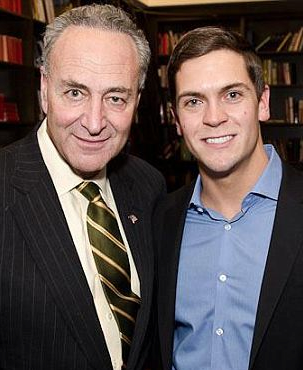
Chuck and Sean-- haimish?

Monday the New York State AFL-CIO rolled out its congressional endorsements, It endorsed all the Democrats-- almost. Steve Israel's DCCC failed to recruit candidates against Chris Collins (in Kathy Hochul's old suburban Buffalo district), Richard Hanna in the swing district he took from Michael Acuri in 2010, and, of course, against Israel's crony Peter King on Long Island. The AFL-CIO ignored Democrats Pat Maher in the Long Island district, ignored Jim O'Connell's race against Collins and actually endorsed Hanna where no Democrat or WFP candidate is even running. The AFL-CIO did endorse every other Democratic challenger in the state-- except multimillionaire Sean Eldridge, who's running against the House's only real moderate Republican, Chris Gibson (NY-19). So, endorsements for vile corporatists Kathleen Rice (NY-04) and Domenic Recchia (NY-11), for Aaron Woolf (NY-21) and Martha Robertson (NY-23) but nothing for Eldridge. Looks like AFL-CIO endorsements-- unlike DCCC backing-- aren't for sale.

It could have been worse. The New York State United Teachers (NYSUT), which refused to endorse Andrew Cuomo, not only didn't endorse Eldridge… they endorsed Gibson! And on top of that, the latest polling shows Eldridge-- in a 50/50 D+1 district-- unable to even break 30%. Worse yet, the Environmental Defense Fund’s Action PAC today launched a $230,000 ad buy in favor of Gibson:


As of the June 30 FEC reporting deadline Gibson had raised $2,261,120 and had $1,910,550 in cash on hand. Eldridge had raised $3,069,179 and had $2,106,220 on hand. But $1,340,000 came right out of Eldridge's personal bank account and most of the rest came from his wealthy friends in Manhattan, where he lives. The U.S. Chamber of Commerce has already spent $350,000 bolstering Gibson and the DCCC's response? $9,136 (mostly in the form of bagels and lox Fed-Exed to Eldridge staffers weekly by Steve Israel).

The irony of all this, is that left to his own devises, Eldridge probably isn't a bad candidate. He may be too young and self-entitled but I hear he's got some progressive instincts. The problem is that in an effort to cement backing from the DCCC and Blue Dog Steve Israel, he's repressed those progressive instincts and come out like a tepid centrist. Multimillionaire tepid centrists may give Israel a woody but that isn't what inspires Democratic voters-- ergo the 29% support even after spending all that money (although, admittedly most of it was wasted on really horrible consultants the DCCC pushed on poor Sean like Jeffrey Pollock at the Global Strategy Group and the maker of insipid SKDKnickerbocker ads, Andrew Shipley). And to add insult to injury, even after Eldridge twisted himself into a pretzel to fit into Israel's mystery meat loser model, the DCCC support for him… doesn't go beyond the bagels and cream cheese.

The DCCC didn't even include Eldridge on their Red-to-Blue list until Eldridge threatened that he and his husband would stop financing Democrats and when Israel announced which districts the DCCC would be investing all those tens of millions of dollars they trick the Democratic grassroots to give them, NY-19 was not on the list. Israel is willing to throw away millions on absurd races in Michigan and Arkansas-- and is pumping money into NY races to help Recchia, Woolf and Robertson (all in tougher districts than Eldridge's) while studiously ignoring NY-19. Their House Majority PAC has taken the same stance: No money for NY-19.

Advice to Eldridge: forget Steve Israel and his failed Blue Dog stratagems. Think about how Elizabeth Warren displaced Republican Scott Brown in Massachusetts, how Alan Grayson beat GOP incumbent Ric Keller (in an R+3 district) and how Matt Cartwright beat Hoyer/Israel-backed Blue Dog Tim Holden last cycle in a Pennsylvania not very far from where you are. Hint: none of them bought into the mystery meat/GOP-light precepts of the Beltway Democrats that are wrecking your campaign. Candidates shall not live on bagels alone.

Eldridge's consultant-heavy campaign can do a lot better than this tepid, uninspiring, cookie-cutter, DCCC-grade crap he released yesterday, an ad that will neither inspire Democrats to go to the polls nor change the mind of a single independent or Republican-- just a total waste of money for everyone but the consultants who are getting rich while leading Eldridge down the garden path:


Labels: , , , , , ,

Friday, March 28, 2014

NAFTA is 20

>


I was thrilled this week when Guy Cecil and Michael Bennet got on board and gave the Shenna Bellows campaign the DSCC's big thumbs up. Hopefully, that will be the beginning of the end for fake moderate Susan Collins in Maine. So, RIGHT ON GUY CECIL and RIGHT ON Michael Bennet. I will refrain from any gratuitously nasty statements about the two of them for at least… well, I hope forever. Next up: South Dakota prairie populist Rick Weiland. I know that may be a tough one for Guy and Mike to swallow but they need to get over the ego trip and do it for the Democrats and, more important, do it for South Dakota and for the American people. The Democrats need to keep this South Dakota Senate seat blue to keep Harry Reid Majority Leader instead of that damn Beltway turtle.

And, OK, I know it's a big tent party and Cecil and Bennet have a right to their conservative beliefs-- even if this are termed "moderate" inside-the-Beltway-- but Weiland is far from a radical and can't we all agree that what he wants to do for ordinary American working families is dead-center among Democrats in the Senate?

He's been traveling across South Dakota for the last 10 months talking about getting ‘big money’ out of politics and taking our country back. Yesterday, he reminded his supporters that he's "visited over 325 of our towns, talking to people in their kitchens, living rooms, cafes, post offices, banks, and businesses.  I’ve walked the neighborhoods and the main streets talking with voters about how big money has turned our government against us. And he warned them about the plutocrats in the GOP who are ready to deploy hundreds of millions of dollars to take over and wreck our democratic system.
All you have to do is turn your gaze to Las Vegas to see how one person-- one billionaire-- is trying to buy buy the next president of the United States. Sheldon Adelson, who spent 100 million dollars on the 2012 elections, is interviewing candidates. Jeb Bush, Chris Christie, Scott Walker, and John Kasich, all potential Republican Presidential candidates, have traveled there to see if Sheldon thinks they are qualified to be President. It has been dubbed the Sheldon Adelson Primary.

They are there to kiss Sheldon's ring and ask for his blessing to run for President. Our political process has now devolved to the point where presidential candidates have to trot out to Las Vegas and apply to a Vegas Kingpin to be president.

This is not how our government is supposed to work. Billionaires are not supposed to pick the next President - the people are. How can anyone say unlimited campaign contributions don't influence elected officials? Have you seen Presidential candidates beating down your door and asking for your support? Then again, we don't have a billion dollars to buy a politician.

This is why I have a constitutional amendment on the back of my business card that would overturn Citizen's United and bring sanity back to our campaigns. It is straightforward: "So that the votes of all, rather than the wealth of the few, shall direct the course of this Republic, Congress shall have the power to limit the raising and spending of money with respect to federal elections…"

We will never get a government “of, for and by the people” as long as billionaires such as Sheldon Adelson can spend 100 million dollars electing the president of their choosing.
And what does that mean, not having a government “of, for and by the people?" Billionaires are celebrating the 20th anniversary of NAFTA. Normal Americans aren't. It worked for them, but not for the rest of us. Yesterday, the AFL-CIO released a report about what we should have learned from the NAFTA debacle. But we haven't learned much and are rushing headlong into something even worse, the Trans-Pacific Partnership. How will we look at the NAFTA experience and make sure not to replicate it on new trade agreements? These are the lessons of NAFTA:
It’s a flawed model that promotes the economic interests of a very few and at the expense of workers, consumers, farmers, communities, the environment and even democracy itself.

While the overall volume of trade within North America due to NAFTA has increased and corporate profits have skyrocketed, wages have remained stagnant in all three countries.

Productivity has increased, but workers’ share of these gains has decreased steadily, along with unionization rates.

NAFTA pushed small Mexican farmers off their lands, increasing the flow of desperate undocumented migrants.

It exacerbated inequality in all three countries.

And the NAFTA labor side agreement has failed to accomplish its most basic mandate: to ensure compliance with fundamental labor rights and enforcement of national labor laws.

The NAFTA architecture of deregulation coupled with investor protections allowed companies to move labor intensive components of their operations to locations with weak laws and lax enforcement. This incentivized local, state and federal authorities to artificially maintain low labor costs by ignoring-- or in some cases actively interfering with-- such fundamental rights as the rights to organize, strike and be free from discrimination.  This dynamic undermined organizing and bargaining efforts even in areas with relatively robust labor laws. Today, it is commonplace for employers to threaten to move south-- whether to South Carolina or Tijuana-- if workers do not agree to cuts in wages and benefits.

Multinationals are uniquely positioned to take advantage of the rules set down in NAFTA-- everything from prohibitions on local input requirements to new ways to challenge regulations, including the investor-to-state dispute settlement process. NAFTA guarantees that foreign investors get enhanced opportunities to fight laws and policies they don’t like that go far beyond the democratic processes available to citizens and domestic businesses.

The Trans-Pacific Partnership (TPP) and other forthcoming trade agreements do not have to repeat the mistakes of the past 20 years. Instead of facilitating corporate actions that exploit workers, pollute the environment and poison consumers, trade deals must move away from this flawed model toward a system that builds sustainable, inclusive development, fosters social mobility, ensures corporate accountability and encourages rather than hinders innovative social policy.

Trade is not an end in itself, but a means to enhance living standards and promote shared prosperity. Unfortunately, the legacy of NAFTA and the flawed U.S. trade policy it both shaped and reflects has been stagnant wages, declining social standards and increased inequality.
That's why we were pushing the DSCC so hard on Shenna Bellows and why we're pushing them so hard on Rick Weiland. Policy is only as good as the people who set it. The Shedlon Adelsons and Koch brothers of the world have bought and are buying all the senators they need to pass more crap trade treaties. They own Susan Collins and they're salivating to get a shameless puppet like Mike Rounds into the Senate. We need men and women-- like Shenna and Rick-- who will stand with the people's senators, Elizabeth Warren, Brian Schatz, Bernie Sanders, Jeff Merkley, a couple of others. A few hours ago, I asked Rick if NAFTA is an issue that resonates with voters in South Dakota. This was his reply:
If you are a big fan of the $5 minimum wage then you're a big fan of big money, and of the NAFTA agreement big money wants to make the prototype for US trade with the entire world.

NAFTA is great at driving American wages down toward an international minimum, like Mexico's $5 minimum wage for example, $5 per DAY!

It's also great at exporting American jobs, eviscerating American labor, and exploding America's trade deficit, all things beloved by big money.

But for the rest of us, who have to feed our kids and try to keep our heads up while our homes are sold out from under us because our jobs went overseas, NAFTA is an unmitigated disaster. In my opinion it is an equally unmitigated ethical disgrace.

The moguls who hand their kids the keys to new Mercedes, then send them off for Spring Break in Cancun using the NAFTA based profits they reap from putting us out of work should be embarrassed to look in the mirror. My wish for them is that they should someday be forced to tell their own kids that their opportunity for a college education just got sent to Tijuana along with their job. Once they have done that, if they still support NAFTA, they will at least have earned the right to do so.
If you'd like to help Shenna and Rick, you can do that here.

Labels: , , , , ,